


Running Your Smart Home by Voice

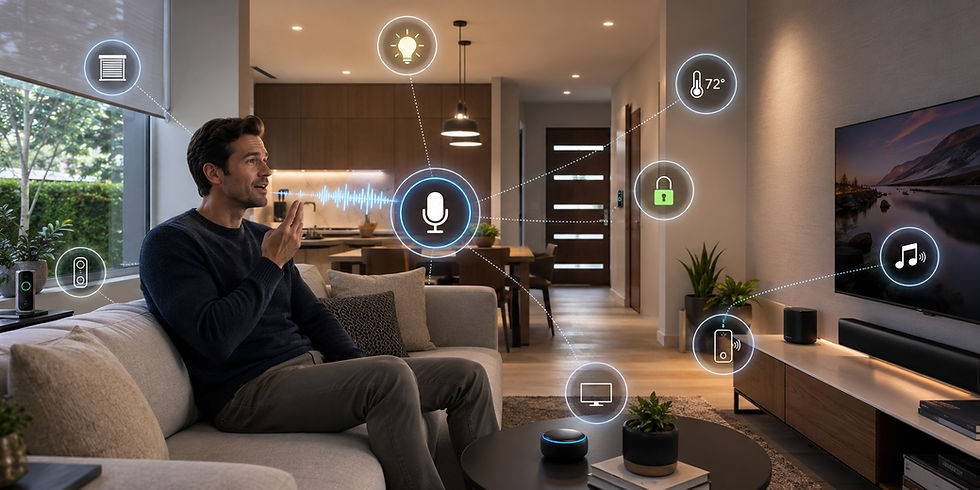
Voice control has quickly become one of the most popular features in modern smart homes. Instead of opening multiple apps to manage lights, temperature, music, security, and other connected devices, homeowners can simply speak a command and let the system respond. For many people, that convenience is what makes a smart home feel truly smart.
As more households adopt connected technology, voice-controlled smart home systems are becoming less of a novelty and more of an everyday tool. Whether you want to turn off the lights, lock the doors, adjust the thermostat, or start your morning routine, using your voice can make daily life easier, faster, and more comfortable.
This is one reason so many homeowners are searching for ways to control their entire smart home with their voice. When the system is planned well, voice control can bring together convenience, accessibility, and automation in one simple experience.
What does it mean to control your smart home with your voice?
A voice-controlled smart home allows you to manage connected devices through spoken commands instead of relying only on switches, remotes, or mobile apps. With the help of a voice assistant and compatible smart home devices, you can tell your home what to do in real time.
That can include simple commands like turning on the kitchen lights or more advanced actions like activating a bedtime routine that dims lights, locks doors, and adjusts the thermostat all at once.
For many homeowners, this is one of the biggest benefits of home automation. It removes extra steps and makes technology feel more natural to use. Rather than managing each device individually, voice control creates a more seamless way to interact with the entire home.
What smart home devices can you control with your voice?
One of the reasons voice control is so appealing is that it can work with a wide variety of smart home devices. A properly connected system can often control multiple categories of technology across the home.
Some of the most common voice-controlled smart home devices include:
Smart lights and dimmers
Smart thermostats
Smart locks
Smart garage door openers
Smart speakers and entertainment systems
Smart blinds or shades
Smart plugs
Smart ceiling fans
Smart cameras and video doorbells
Smart appliances
Smart irrigation controllers
For example, instead of walking through the house turning everything off manually, a homeowner can say a single phrase to shut off lights, lower the temperature, and activate a nighttime routine.
This kind of convenience is a major reason people invest in smart home voice control in the first place.
Why voice control makes smart homes more convenient
The biggest benefit of voice-controlled home automation is convenience. Many everyday tasks become easier when you can simply say what you want instead of stopping to open an app or adjust something manually.
Voice control can be especially helpful when:
Your hands are full
You are already in bed
You are cooking
You are carrying groceries
You want to control multiple devices at once
You need quick access to lights or temperature settings
For busy families, voice commands can simplify routines throughout the day. For older adults or people with mobility concerns, controlling smart devices with voice commands can also improve accessibility and independence.
In many homes, this is what turns smart home technology from something interesting into something truly useful.
How smart home routines work with voice commands
If individual voice commands are useful, routines are what make a smart home feel fully integrated. A routine allows one spoken phrase to trigger several actions at once.
For example, a “good morning” routine might:
Turn on selected lights
Raise the thermostat slightly
Open motorized shades
Start music or news
Turn on a coffee maker connected to a smart plug
A “good night” routine might:
Turn off downstairs lights
Lock smart doors
Close the garage
Lower the thermostat
Arm security features
Using voice-controlled smart home routines helps reduce the number of steps required to manage the house. It also creates a more customized experience based on the way you actually live.
This is one of the most powerful ways to control your entire smart home with your voice because it allows you to manage groups of devices through one simple command.
What you need for whole-home voice control
If you want to control your entire smart home with voice commands, a few factors matter more than others. The most important is compatibility. Not every smart device works equally well with every system, so a connected home works best when devices are chosen with integration in mind.
A strong voice-controlled smart home setup usually includes:
A reliable voice assistant platform
Compatible smart home devices
Strong Wi-Fi coverage throughout the home
Clear device naming
Organized rooms and groups
Simple routines based on daily habits
Device naming is more important than many people expect. Commands are easier and more reliable when devices have clear names like “Kitchen Lights,” “Primary Bedroom Fan,” or “Patio Speakers.” Confusing or duplicated names can make voice control frustrating.
Wi-Fi coverage also plays a major role. If smart devices are installed in areas with weak signal, voice commands may fail, respond slowly, or behave inconsistently. In many cases, what seems like a smart device problem is really a network issue.
Common problems with voice-controlled smart homes
While voice control is convenient, it works best when the system is well planned. Homeowners sometimes run into issues when they add too many devices too quickly or mix products that do not work smoothly together.
Some common voice control problems include:
Smart devices not responding
Voice assistant misunderstanding commands
Weak Wi-Fi signal
Inconsistent compatibility between brands
Duplicate or confusing device names
Delayed responses
Routines that are too complicated
The best way to avoid these issues is to keep the system organized and focus on practical everyday use. Start with the devices and commands you are most likely to use, then build from there.
A smart home should feel easier to manage, not more complicated.
Who benefits most from voice-controlled smart home technology?
Almost anyone can benefit from voice control, but it can be especially valuable for certain households.
Busy families often use it to simplify lighting, entertainment, and daily routines. Homeowners who entertain guests may enjoy how quickly they can change the atmosphere with a single command. Seasonal homeowners may appreciate the convenience of managing connected devices easily when they are in residence.
Voice-controlled smart homes can also be especially helpful for older adults. Being able to adjust lights, temperature, reminders, or communication devices by voice can support safer and more comfortable living at home. For people with physical limitations, reducing the need to reach switches or use multiple apps can make a meaningful difference.
In that way, smart home voice control is not just about convenience. It can also improve accessibility and ease of living.
Why voice control is becoming essential in modern smart homes
As smart home technology becomes more common, homeowners increasingly want systems that feel intuitive. Voice control does exactly that. It creates a simple bridge between people and technology by allowing natural spoken commands to handle everyday functions.
Instead of thinking in terms of individual devices, homeowners start thinking in terms of experiences:
getting ready for bed
leaving the house
waking up in the morning
relaxing for the evening
adjusting comfort without interrupting what they are doing
That shift is what makes voice control such an important part of modern home automation. It is not just about controlling smart devices. It is about making the entire home easier to use.
Controlling your entire smart home with your voice is one of the simplest ways to make connected living feel more practical. With the right setup, you can manage lights, climate, security, entertainment, and routines through easy spoken commands that save time and reduce friction.
A well-designed voice-controlled smart home is not about adding technology for the sake of it. It is about creating a home that responds more naturally to your needs. When devices are compatible, routines are useful, and the system is easy to use, voice control can become one of the most valuable features in the entire home.
At Naples Smart Home Watch we install smart home monitoring systems in Naples and the surrounding areas that help homeowners remotely track leaks, temperature, humidity, cameras, entry activity, and critical home conditions while home or away. Ready to protect your home? Schedule your free consultation today.


Comments